Why Did Leviticus 16 Require Two Goats on the Day of Atonement?
On Israel’s annual Day of Atonement, one goat was sacrificed to purify the sanctuary while another was sent into the wilderness bearing the people’s confessed iniquities. Leviticus 16 explains how these complementary rituals addressed the defilement of sacred space and the removal of sin.

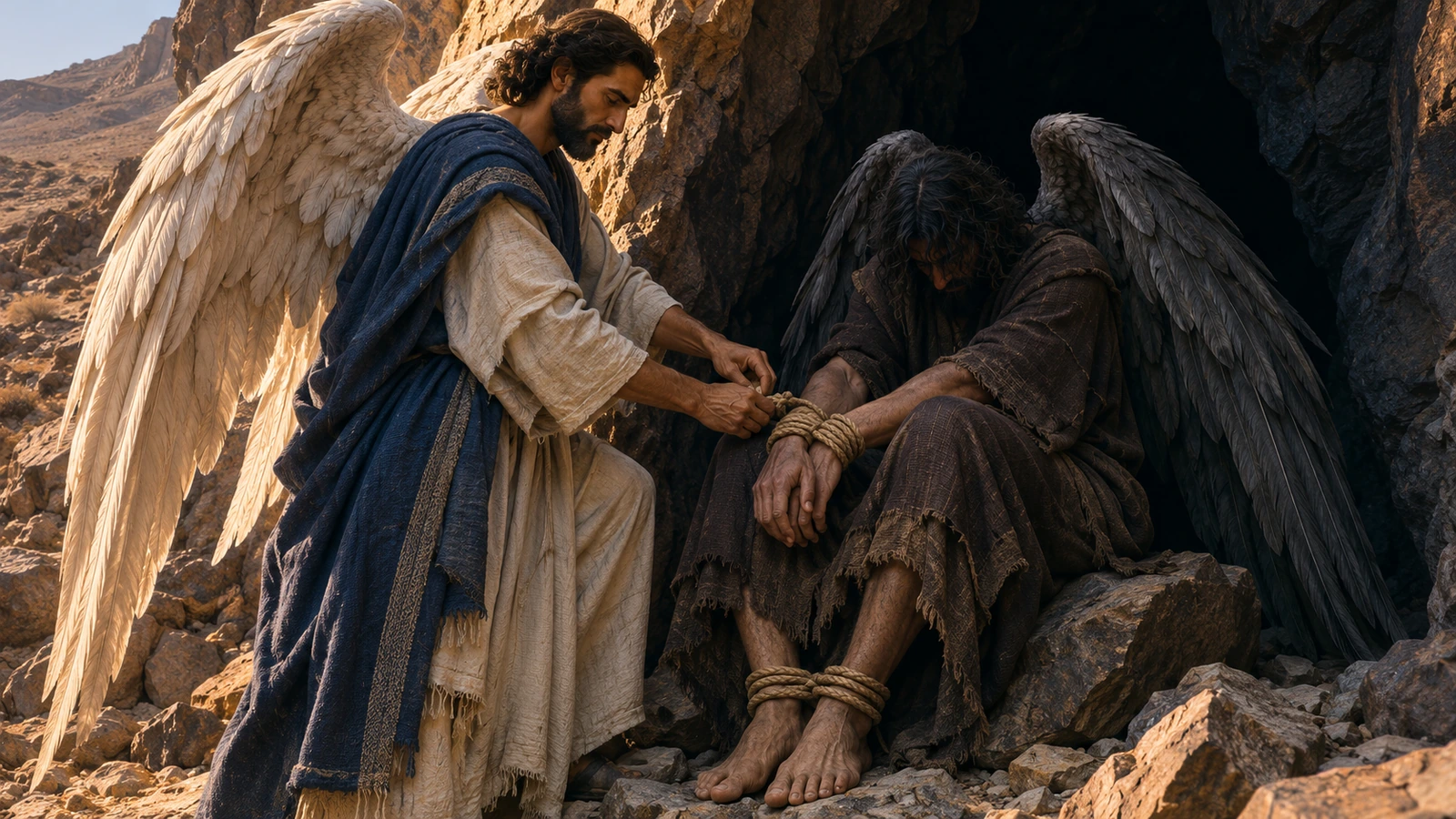
Source: AI-generated image created for Beyond The Known.
Two goats are brought before the LORD at the entrance of the Tent of Meeting. Aaron casts lots, assigning one animal to the LORD and the other to Azazel. Their paths will soon separate. The first goat is slaughtered. Its blood is carried behind the veil, into the most restricted part of Israel’s sanctuary. The second remains alive until Aaron places both hands on its head, confesses the people’s offenses, and sends it away into the wilderness.
Why did atonement require two such different actions? Leviticus 16 answers through the functions of the animals. The sacrificed goat provides blood for purifying the sanctuary from Israel’s impurities and sins. The living goat bears the confessed iniquities away from the community. Together, these rites address a problem larger than individual forgiveness: how a holy God could continue dwelling among a people whose lives were marked by impurity and wrongdoing.
Our previous study, Why Does Leviticus 15 Treat Bodily Discharges as Unclean?, ended with a warning against defiling the Tabernacle. Leviticus 16 takes up the question left unresolved by that warning. If Israel’s impurities threatened the sacred dwelling, how was the dwelling itself to be cleansed? The answer begins with an unexpected reminder of death. Before describing the goats, the chapter returns to the fate of Aaron’s sons, Nadab and Abihu. Their unauthorized approach to the LORD provides the setting for a ceremony in which access to the divine presence is possible only under carefully defined conditions.
The identity of Azazel introduces another difficulty. Was the name associated with a wilderness being, a remote place, or the removal of sin? The evidence has produced competing scholarly explanations. Yet the ceremony’s basic meaning does not depend upon resolving every uncertainty surrounding that word. The instructions themselves reveal a carefully ordered progression: the high priest prepares, enters the sanctuary, applies sacrificial blood, removes the people’s iniquities, and completes the observance required of Israel each year.
Why Does Leviticus 16 Begin with Nadab and Abihu? (16:1–2)
The LORD speaks to Moses after the deaths of Aaron’s two sons, who had approached the divine presence and died. Their story appears in Why Did Nadab and Abihu Die After Offering Unauthorized Fire?, our study of Leviticus 10. Nadab and Abihu had presented fire and incense that the LORD had not commanded. The precise nature of their violation remains uncertain, but the outcome was unmistakable. Leviticus 16 now directs Aaron not to enter the inner sanctuary whenever he wishes.
The prohibition concerns the space behind the veil, before the cover of the ark, where the LORD declares that he will appear in a cloud. Aaron’s priestly position does not grant him unrestricted access.
The Danger Behind the Veil
The Tabernacle contained areas distinguished by their sacred character and the restrictions governing entry. The innermost chamber housed the ark of the covenant. Its cover is called the kappōret (כַּפֹּרֶת), often translated “mercy seat” or “atonement cover.” The term is associated with a central object in the Day of Atonement ceremony, although its precise linguistic relationship to the Hebrew vocabulary of atonement remains a matter of discussion. The ark’s cover will receive sacrificial blood later in the chapter. For the moment, however, the instruction emphasizes the danger of an improper approach.
The LORD’s presence is not available for casual inspection. This explains why the opening references Aaron’s sons rather than beginning immediately with the annual calendar. The earlier tragedy establishes what is at stake when a priest approaches sacred space. Leviticus 16 provides an authorized procedure in place of an unrestricted entrance.
Did the High Priest Enter Only Once?
The annual observance establishes the special occasion on which the high priest may enter the Most Holy Place. It does not reduce the entire ceremony to one physical crossing of the veil. The instructions involve bringing incense and subsequently applying blood from different offerings. These are distinct ritual actions within the same authorized observance. The restriction is therefore best understood in terms of the occasion and its prescribed conditions. Aaron may enter for the appointed service, but he cannot decide independently when or how to approach the divine presence.
Why Did Aaron Need Special Clothing and His Own Sacrifice? (16:3–6)
Before the community’s goats are offered, Aaron must prepare himself. He brings a bull for a purification offering and a ram for a burnt offering. He bathes and puts on sacred linen garments: a tunic, undergarments, sash, and head covering. The clothing is notably different from the elaborate high-priestly attire described elsewhere in the Torah.
Why Were Linen Garments Required?
Leviticus specifies the garments but does not provide an explicit symbolic explanation for their simplicity. Some interpreters associate the linen clothing with humility or the particular purity required for the occasion. Those readings may be theologically meaningful, but they remain interpretations rather than stated reasons. The contrast with Aaron’s earlier consecration is worth observing. Our study of Leviticus 8 examined the washing, clothing, anointing, and sacrifices associated with the installation of Israel’s priests.
In Leviticus 16, Aaron already holds the high-priestly office. His preparation concerns an exceptional act of service within that office. The garments belong to a specified ritual sequence, not to an improvised expression of personal devotion.
Why Did the High Priest Make Atonement for Himself?
Aaron’s bull is presented for himself and his household. Only afterward does he perform the blood rite using the goat designated for the people. The distinction prevents the high priest from appearing as someone who stands outside the need for atonement. He represents the community before the LORD, but he must first address his own household’s place within the ritual. No particular offense committed immediately before the ceremony is identified. The offering belongs to the established requirements of the day.
Aaron’s preparation also makes clear that the two goats are not the entire sacrificial provision. The ceremony involves a bull, the goats, burnt offerings, incense, and further procedures for handling the remains. Each has its place in the prescribed order.
Why Were Two Goats Chosen by Lot? (16:5–10)
The Israelite community supplies two male goats for the purification rite, along with a ram for a burnt offering. Aaron presents the goats before the LORD at the entrance of the Tent of Meeting. He then casts lots to determine their different assignments. One lot is designated for the LORD; the other is for Azazel. The first goat will be slaughtered as a purification offering. The second will remain alive before the LORD until it is sent into the wilderness.
The text does not describe the physical appearance of the lots or how they were handled. Later Jewish traditions supply additional details, but these belong to the ceremony’s subsequent interpretive history. What matters in Leviticus 16 is the division of roles.
Were Both Goats Part of One Offering?
Verse 5 introduces the two animals together in connection with the community’s purification offering. Their subsequent treatment, however, differs sharply. The goat designated for the LORD is killed, and its blood is used within the sanctuary. The other is presented alive, receives the people’s confessed iniquities, and is led away. Scholars have debated how the living-goat rite should be classified. Does it constitute a sacrifice in a broader sense, or should it be distinguished from sacrificial slaughter?
Yaw Adu-Gyamfi examines this question in “The Live Goat Ritual in Leviticus 16,” arguing for a distinctive sacrificial character while emphasizing the removal of sin. The debate concerns ritual classification rather than the sequence itself. The biblical instructions clearly give the animals separate functions within the annual work of atonement.
Who or What Was Azazel?
The Hebrew name ʿazāʾzēl (עֲזָאזֵל) occurs in the instructions concerning the living goat. Its meaning remains disputed. Some English Bibles preserve Azazel as a name, while others use “scapegoat” or a translation associated with removal. Those differences arise from competing interpretations of the Hebrew expression.
Was Azazel a Wilderness Being?
A prominent scholarly interpretation understands Azazel as the name of a supernatural being associated with the wilderness. One argument comes from the parallel wording of the two lots: one is “for the LORD,” while the other is “for Azazel.” If the first designation names a divine recipient, the second may likewise refer to a personal being. The goat’s destination in the wilderness is also relevant because desert regions could carry associations with dangerous or disorderly powers in ancient religious thought.
This interpretation has substantial support, but the passage itself does not explain Azazel’s identity. Later Jewish literature develops traditions concerning a figure bearing this name. Such material is important for the history of interpretation without necessarily establishing what every Israelite understood the term to mean when this law took shape. Identifying Azazel directly with Satan would require additional argument.
Could Azazel Refer to a Place or to Removal?
Other proposals understand the word as a designation for a remote wilderness location or as an expression connected with carrying something away. The traditional English “scapegoat” reflects the emphasis on the departing animal. Jacqueline C. R. de Roo has proposed a different explanation connecting the expression with divine wrath. Her interpretation illustrates how varied the scholarly attempts to understand the word have been. No single proposal has ended the debate.
The uncertainty is real, but it should not overshadow the actions specified in the ceremony. The goat is presented alive before the LORD. The people’s iniquities are confessed over it, and it is sent beyond the camp.
Was the Goat Offered to a Demon?
Leviticus does not command Aaron to slaughter the living goat on an altar dedicated to Azazel. Its departure occurs within the ritual the LORD has prescribed. If Azazel refers to a supernatural being, that identification raises questions about the goat’s destination and the possible historical background of the rite. It does not, by itself, prove that Israel was commanded to worship a demon. Dominic Rudman approaches the ceremony through the symbolic removal of sin into the wilderness, interpreting that region as a place associated with chaos and separation from the ordered community.
His proposal is a scholarly reading of the ritual, not an explanation explicitly supplied by the biblical writer. The most secure observation remains the goat’s function: it carries confessed iniquities away from Israel. The meaning of its destination’s name is a separate, more difficult question.
Why Was Incense Required Before the Blood Ritual? (16:11–14)
After slaughtering the bull for his own purification offering, Aaron takes burning coals from the altar before the LORD and two handfuls of finely ground aromatic incense. He carries them behind the veil. There he places the incense upon the fire, producing a cloud that covers the ark’s cover. The instruction again includes a warning about death. The incense cloud is not decorative atmosphere. It is part of the prescribed protection associated with approaching the divine presence.
This moment recalls Leviticus 10. Nadab and Abihu died in connection with an unauthorized presentation of fire and incense. Aaron now receives detailed instructions governing how fire and incense must be used during the most restricted ceremony of the year. The comparison does not settle precisely what his sons did wrong. It demonstrates, however, that priestly approach to the LORD was governed by requirements that could not be disregarded.
Why Was Blood Sprinkled Near the Ark?
Following the incense procedure, Aaron takes blood from the bull and applies it in relation to the ark’s cover. He also sprinkles blood seven times before it. The Hebrew instructions include directional language whose exact spatial reconstruction has been discussed by interpreters. The principal action is clear: blood from the high priest’s purification offering is brought into the Most Holy Place. This is the beginning of the inner sanctuary’s blood rite.
The number of sprinklings and the designated location belong to the prescribed procedure. Leviticus does not explain every individual gesture through a separate symbolic meaning. The text gives greater attention to what these actions accomplish when the people’s goat is introduced.
Why Did the Sacrificed Goat’s Blood Purify the Sanctuary? (16:15–19)
Aaron slaughters the goat designated for the LORD and takes its blood behind the veil. He applies it in the manner prescribed for the bull’s blood. Verse 16 then states the purpose of the ceremony. Atonement is made for the inner sanctuary because of the Israelites’ impurities and their transgressions, including their sins. The Tent of Meeting also requires purification because it stands among a people whose lives are affected by impurity.
This is one of the most important explanations in Leviticus. The people are not the only concern. The sacred dwelling itself is involved.
How Could Israel’s Sins Affect the Sanctuary?
Leviticus presents the Tabernacle as the LORD’s dwelling among Israel. The preceding chapters explain how various conditions could produce impurity. Their regulations include animal carcasses, childbirth, skin afflictions, affected houses, and bodily discharges. The warning in Leviticus 15:31 connects those conditions with the danger of defiling the sanctuary. Leviticus 16 now provides the annual procedure for purifying sacred space. The relationship between individual impurity and sanctuary defilement has generated considerable scholarship.
Jacob Milgrom developed an influential interpretation in which impurities and sins have consequences for the sanctuary, making its purification necessary. The precise mechanism by which different forms of impurity were understood to affect sacred space remains a matter of interpretation. The textual claim, however, is direct: the sanctuary receives atonement because of Israel’s impurities and wrongdoing.
What Did the Blood Accomplish?
The Hebrew verb kipper (כִּפֶּר), commonly translated “make atonement,” is central to the ritual. In this passage, atonement includes purifying the sacred places. The offering called ḥaṭṭāʾt (חַטָּאת), frequently translated “sin offering,” is therefore also described by many scholars as a “purification offering.” That terminology draws attention to its function within the ceremony. In Leviticus 4, purification offerings address specified acts of unintentional wrongdoing. Leviticus 16 extends the discussion to an annual rite concerning the accumulated impurities and offenses of the community.
The blood is applied to sacred locations. The ceremony therefore involves more than a spoken declaration that individuals have been forgiven. The innermost sanctuary, the Tent of Meeting, and the altar must be addressed through the prescribed actions.
Why Was the Altar Also Cleansed?
Aaron applies blood from the bull and the goat to the horns of the altar and sprinkles blood upon it seven times. Verse 19 explicitly describes the result: the altar is cleansed and consecrated from the impurities of the Israelites. The identification of the altar in verse 18 has been debated. Some interpreters understand it as the altar of burnt offering in the courtyard. Others consider a connection with the incense altar, particularly in light of Exodus 30:10.
Leviticus does not settle every question about the precise route of Aaron’s movements. It does specify that the altar is included in the ritual cleansing. The scope of atonement extends through the sacred complex rather than stopping with the ark’s cover.
Why Was No One Else Allowed in the Tent?
Verse 17 requires the Tent of Meeting to remain empty of other people while Aaron performs the designated atonement rites. The high priest carries out the central service on behalf of his household and the entire assembly. The restriction reinforces the exceptional character of the ceremony. The community’s purification depends upon actions performed in sacred space, but the people do not accompany Aaron into that space. Even other priests are excluded during the specified interval. The result is a carefully bounded form of access: one authorized priest, performing particular actions, at an appointed time.
Why Did Aaron Confess Israel’s Sins Over the Living Goat? (16:20–22)
After completing the atonement rites for the inner sanctuary, Tent of Meeting, and altar, Aaron brings forward the living goat. He places both hands upon its head. Then he confesses the Israelites’ iniquities, transgressions, and sins, placing them upon the animal. A designated man leads the goat away into the wilderness.
What Was the Meaning of the Two-Handed Gesture?
Earlier sacrificial instructions frequently describe a person placing a hand upon an animal. Leviticus 16:21 specifically requires both hands. That unusual detail accompanies a clear statement of what the priest does through the confession. The people’s offenses are placed upon the goat’s head. Adu-Gyamfi discusses the gesture as representative of the community and examines its relationship to the removal of sin. The gesture’s precise ritual theory may be debated, but the association with confession is explicit.
The animal does not depart without a defined purpose. It is made to bear the offenses acknowledged by the high priest.
Which Sins Were Confessed?
The confession uses several Hebrew terms. ʿĀwōn (עָוֹן) refers to iniquity or guilt, while peshaʿ (פֶּשַׁע) can convey transgression or rebellion. The chapter also uses the broader language of sin. These terms should not be forced into a rigid system in which each always describes a completely separate category. Together, they communicate the breadth of the offenses confessed over the goat. The annual rite concerns more than isolated cases of accidental disobedience.
Its language includes serious transgression and rebellion alongside the impurities addressed through the sanctuary’s blood rites. The distinction between the sanctuary’s cleansing and the removal of confessed offenses is fundamental to the ceremony.
Where Did the Living Goat Take Israel’s Iniquities?
The goat is led into the wilderness, to a remote or isolated region. Verse 22 states that it carries the people’s iniquities away. The direction of movement matters. The animal leaves the camp rather than entering the sanctuary. Its destination stands beyond the settled area occupied by the community.
Was the Goat Killed in the Wilderness?
Leviticus 16 describes the goat being sent away and released. It does not command that the animal be pushed from a cliff. Later Jewish tradition records a more elaborate procedure. Mishnah Yoma 6:6 describes the goat being taken to a cliff and pushed down. Other details associated with the later ceremony include the use of crimson material. These sources help historians understand the development of Jewish Day of Atonement practice.
They do not establish that every detail was already prescribed in the wilderness instructions given to Aaron. A reconstruction of Leviticus 16 itself should therefore distinguish the living goat’s departure from the later Temple-era descriptions of its death.
Why Was the Goat Sent Away Rather Than Returned?
The prescribed action gives physical expression to removal. Aaron has confessed Israel’s offenses over the animal, and it carries them into a region outside the community. The text provides no instruction for its return. This is the distinctive function of the living goat. The sacrificed animal’s blood is used within the sanctuary. The second animal bears the burden placed upon it beyond Israel’s inhabited space. The two procedures belong to a recurring annual ceremony.
Leviticus does not claim that sending away the goat once would prevent future wrongdoing or permanently eliminate the need for atonement. The observance is to be repeated each year.
Why Did the Ceremony Continue After the Goat Departed? (16:23–28)
The sending away of the living goat does not complete every requirement of the day. Aaron returns to the Tent of Meeting, removes the sacred linen garments used during his entrance into the inner sanctuary, and leaves them there. He bathes in a holy place and changes into his other priestly clothing. Then he offers the burnt offerings for himself and for the people. The fat of the purification offering is burned upon the altar.
The remains of the bull and slaughtered goat are carried outside the camp, where their hides, flesh, and waste are burned. These instructions preserve distinctions among different elements of the sacrificial process. The blood has been used at the sanctuary. The remaining animal parts are handled according to their own requirements.
Why Did the Attendants Have to Wash?
The man responsible for leading the living goat away must wash his clothing and bathe before returning to the camp. The same requirement applies to the person who burns the sacrificial remains. Both have participated in actions involving the removal of material beyond Israel’s inhabited area. Their washing marks the conditions under which they may return. The chapter does not assign a separate theological meaning to every act of bathing.
It does, however, regulate the movements of those who leave the camp just as carefully as it governs Aaron’s approach to the sanctuary. The annual ceremony involves distinct transitions between sacred space, the community, and the wilderness. Each is subject to prescribed boundaries.
Why Was the Day of Atonement Observed Every Year? (16:29–34)
The final verses establish the ceremony as an annual observance. It takes place on the tenth day of the seventh month. The Israelites must practice self-denial and refrain from work. The requirements extend to the native-born population and resident foreigners. The day is described as a sabbath of complete rest. The high priest who succeeds Aaron is responsible for performing the ritual in subsequent generations.
Why Was the Entire Community Required to Participate?
Most of the central actions are performed by the high priest, but the observance concerns all Israel. The people participate through the requirements governing the day. Their cessation of work and self-denial accompany the priestly service performed on their behalf. The Hebrew expression often translated “afflict yourselves” or “deny yourselves” became closely associated with fasting in Jewish tradition. Leviticus 16 does not supply every later detail concerning the observance. It directly requires self-denial and complete rest from work.
These communal obligations distinguish the day from an ordinary occasion of sacrifice. Verse 30 describes its purpose in terms of cleansing the Israelites from their sins before the LORD.
Why Was Atonement Repeated Annually?
Israel’s life continued after each observance. New instances of impurity and wrongdoing could arise, and the Tabernacle remained the sacred dwelling among the people. The law therefore establishes a recurring occasion for atonement. The annual requirement also explains why the ceremony’s significance should not be limited to an individual confession. It addresses the community and the sanctuary within Israel’s continuing covenantal life. The final statement confirms its regularity: atonement is to be made once each year for all the sins of the Israelites.
How Does the Day of Atonement Relate to Hebrews 9?
The Letter to the Hebrews offers one of the New Testament’s most sustained interpretations of Israel’s sanctuary and sacrificial system. Hebrews 9 refers to the high priest’s restricted entrance into the inner sanctuary and the blood associated with that annual service. The author then contrasts the recurring rites with the work attributed to Jesus Christ.
How Does Hebrews Interpret Christ’s Priesthood?
Hebrews presents Jesus in relation to priesthood, sacrifice, and entrance into the heavenly sanctuary. The comparison depends upon the distinctive features of the earlier system: restricted access, sacrificial blood, and repeated offerings. The argument develops these features within a Christian theological understanding of Christ’s death and priestly ministry. That interpretation belongs to the New Testament’s reception of Leviticus. It should not erase the earlier law’s own setting, in which the ceremony concerns Aaron, the Tabernacle, and the Israelite community.
Does Jesus Represent Both Goats?
Christian readers have often connected the two goats with different aspects of Christ’s work. The sacrificial blood and the removal of sins both lend themselves to later theological comparison. Hebrews, however, does not provide an exhaustive allegory identifying every detail of the goats’ actions with a corresponding event in Jesus’ life. Its principal argument concerns Christ’s priestly offering and access to the heavenly sanctuary. A careful comparison can recognize the theological connections without treating Leviticus 16 as though its only purpose were to anticipate later Christian interpretation. The original ceremony remains intelligible within Israel’s own system of purity, sacrifice, and sacred space.
The Deeper Discovery
The Blood Goes Inward; the Living Goat Goes Outward
The most revealing pattern in Leviticus 16 is not found in an obscure numerical code or a hidden definition of Azazel. It appears in the movement of the ritual itself. The two goats begin together before the LORD. After the lots are cast, their roles divide. Blood from the slaughtered goat is carried inward, crossing the veil into the Most Holy Place. The living animal moves in the opposite direction. It is led beyond the camp, carrying the iniquities placed upon it.
The contrast joins two distinct concerns. The sanctuary must be purified. Israel’s confessed wrongdoing must be removed. These are complementary actions, not interchangeable ones. The blood is applied to sacred locations. The living goat is not taken behind the veil. The iniquities are confessed over the living animal. The slaughtered goat is not sent into the wilderness. Their difference explains why the ceremony requires both.
The Order of the Ritual Reveals an Important Priority
Verse 20 contains a detail that is easily missed. The living goat is brought forward only after Aaron has finished making atonement for the Most Holy Place, the Tent of Meeting, and the altar. The sanctuary’s purification comes first. Only then does Aaron place both hands upon the living goat and confess Israel’s offenses. This order is stated directly in the instructions. Its significance can be understood without claiming that the text explicitly provides a symbolic theory for every stage.
The ceremony does not begin with the dramatic departure of the scapegoat. It first addresses the sacred dwelling that stands among the people. The removal of confessed iniquities follows the purification of that space. This is an important correction to interpretations that make the living goat the entire meaning of the Day of Atonement. Its departure is memorable, but the blood rites have already performed an essential part of the ceremony.
The Chapter Is Framed by the Danger of Approaching God
Another connection appears between the opening verses and the sanctuary procedure. Leviticus 16 begins after the deaths of Nadab and Abihu. Aaron is warned against approaching the innermost sanctuary whenever he chooses. The subsequent instructions establish a carefully regulated means of entry. He washes, wears the prescribed garments, makes atonement for himself, carries incense behind the veil, and applies sacrificial blood. No one else may remain in the Tent of Meeting during the specified rites.
The chapter therefore moves from a dangerous, unauthorized approach to an authorized form of priestly service. The contrast becomes particularly meaningful when read against Leviticus 10. The earlier episode recounts the deaths of priests who presented fire and incense in a manner the LORD had not commanded. Leviticus 16 describes exactly how the high priest is to use incense during a restricted approach to the divine presence. The correspondence does not identify every element of Nadab and Abihu’s offense. It does show that access to sacred space is governed by divine instruction rather than priestly discretion.
From Leviticus 15 to the Wilderness Beyond the Camp
A wider literary movement completes the picture. Leviticus 15 ends with the warning that Israel must not defile the Tabernacle through impurity. Leviticus 16 responds by purifying the sanctuary. But the ceremony does not end within that sacred space. The living goat carries the people’s iniquities beyond the community, while the remains of the slaughtered purification offerings are also removed for disposal outside the camp. These outward movements involve different materials and purposes, yet they belong to the same carefully structured day.
The sanctuary, the camp, and the wilderness form distinct locations within the ritual. The high priest’s actions connect them without erasing the boundaries between them. This spatial organization gives the chapter unusual coherence. The law begins with a restriction on entering the place of God’s presence and proceeds through actions that cleanse that place and remove what must not remain among the people. The two goats stand at the center of this movement.
One supplies the blood required inside the sacred dwelling. The other carries confessed iniquities beyond Israel’s inhabited world. Leviticus 16 thus addresses a question running through the book since the Tabernacle was established: How can the LORD continue dwelling among Israel when the people are subject to impurity and capable of serious wrongdoing? The answer is not unrestricted access, nor is it the denial of human guilt. The chapter provides an ordered annual ceremony through which sacred space is purified and the community’s iniquities are removed. That is why both goats are necessary.
Frequently Asked Questions
Why were two goats required on the Day of Atonement?
The goats had complementary functions. The sacrificed animal provided blood for purifying sacred space, while the living goat carried Israel’s confessed iniquities into the wilderness.
What does Azazel mean in Leviticus 16?
The meaning remains debated. Interpretations include a wilderness being, a remote location, or a term associated with removal. The goat’s role is clearer than the name’s precise meaning.
Was the scapegoat offered to Satan?
Leviticus does not describe a sacrifice offered on an altar to Satan. The living goat is presented before the LORD and sent away under the prescribed ritual. Identifying Azazel with Satan requires arguments beyond the chapter itself.
Was the living goat killed?
Leviticus 16 describes the goat being sent away into the wilderness. Later Jewish tradition includes a procedure in which it was pushed from a cliff.
Why did the high priest offer a bull for himself?
The bull provided the purification offering required for Aaron and his household before he performed the blood rites associated with the people.
Why did the sanctuary need atonement?
Leviticus 16:16 connects its purification with Israel’s impurities and sins. The sanctuary stood among the people and was subject to the prescribed annual cleansing.
Why was the Day of Atonement observed annually?
The law establishes a recurring observance on the tenth day of the seventh month. It addresses the purification of sacred space and the sins of Israel within the community’s continuing covenant life.
What Comes Next?
Leviticus 16 brings the preceding purity regulations to their annual climax. Aaron enters the innermost sanctuary under carefully defined conditions. Sacrificial blood is applied to sacred space, and the living goat carries Israel’s iniquities away. The chapter establishes how atonement is performed for the sanctuary and the people. Leviticus 17 turns to a related question about the blood used in these ceremonies. Sacrifice must occur within the prescribed sanctuary framework, and consuming blood is forbidden.
The law explains that the life of the flesh is in the blood and that blood has been given for atonement upon the altar. This creates a striking distinction. Blood is essential to the sacrificial system, yet it cannot be treated as ordinary food. Why does its association with life make it suitable for atonement while placing it under such a serious prohibition? Next Study: Why Does Leviticus 17 Restrict Sacrifice and Forbid Eating Blood?
Series Navigation
Previous Study: Why Does Leviticus 15 Treat Bodily Discharges as Unclean? Related Study: Why Did Leviticus 14 Require Birds, Blood, and Oil for Cleansing? Next Study: Why Does Leviticus 17 Restrict Sacrifice and Forbid Eating Blood? Explore the Series: Leviticus Studies
Selected Sources
- Hebrew Bible. Leviticus 16. Hebrew text and translations. Primary source for the Day of Atonement, the two goats, the sanctuary’s purification, and the annual requirements.
- New American Bible, Revised Edition. Leviticus 16 and Explanatory Notes. United States Conference of Catholic Bishops. Relevant to the ritual sequence, the ark’s cover, priestly restrictions, and the interpretation of Azazel.
- Adu-Gyamfi, Yaw. “A Literary and Ritual Analysis of Leviticus 16.” Scriptura 122, no. 1 (2023). Examines the stages of the annual ceremony, including the cleansing of sacred objects and the removal of Israel’s impurities and sins.
- Adu-Gyamfi, Yaw. “The Live Goat Ritual in Leviticus 16.” Scriptura 112 (2013): 1–10. Studies the two-handed gesture, the confession over the living goat, its ritual classification, and its role in removing sin.
- Rudman, Dominic. “A Note on the Azazel-goat Ritual.” Zeitschrift für die alttestamentliche Wissenschaft 116, no. 3 (2004): 396–401. Proposes a reading in which the goat’s departure removes sin into a wilderness associated with chaos. The published abstract and bibliographic record were consulted.
- de Roo, Jacqueline C. R. “Was the Goat for Azazel Destined for the Wrath of God?” Biblica 81, no. 2 (2000): 233–242. Presents a distinct linguistic and theological proposal concerning Azazel. The published abstract and bibliographic record were consulted.
- Mishnah. Yoma 6:6. Later Jewish description of the living goat being taken to a cliff. Used to distinguish subsequent ritual practice from the instructions in Leviticus 16.
- Letter to the Hebrews. Hebrews 9:1–28. Primary New Testament source for the Christian interpretation of priestly access, sacrificial blood, and atonement.