Why Does 1 Enoch Ask Its Readers to Watch the Seasons Before the Watchers Descend?
Green leaves and summer shade prepare the hearer for a question about human speech before the story reaches Mount Hermon.
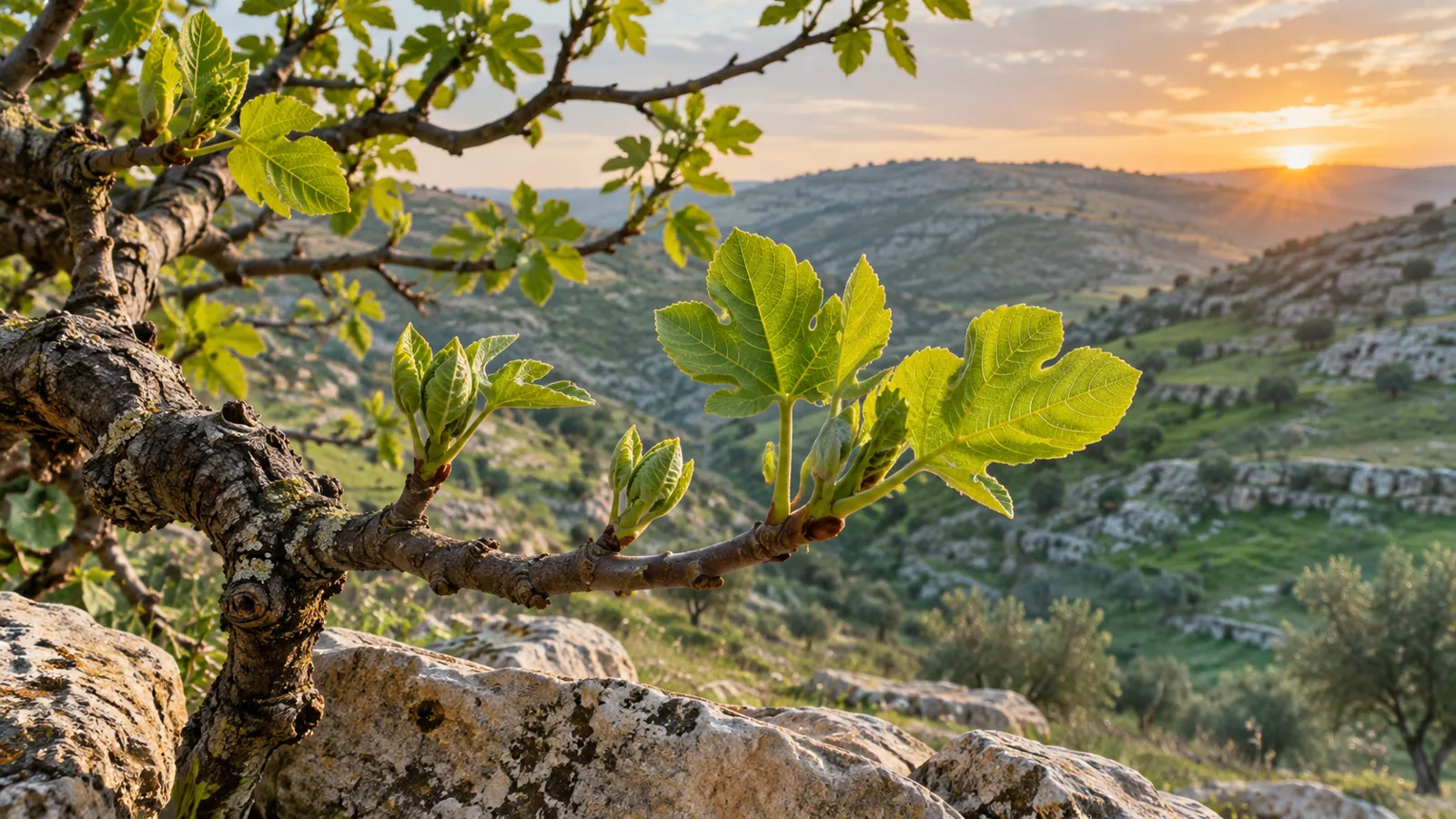
Source: AI-generated editorial illustration for Beyond The Known.
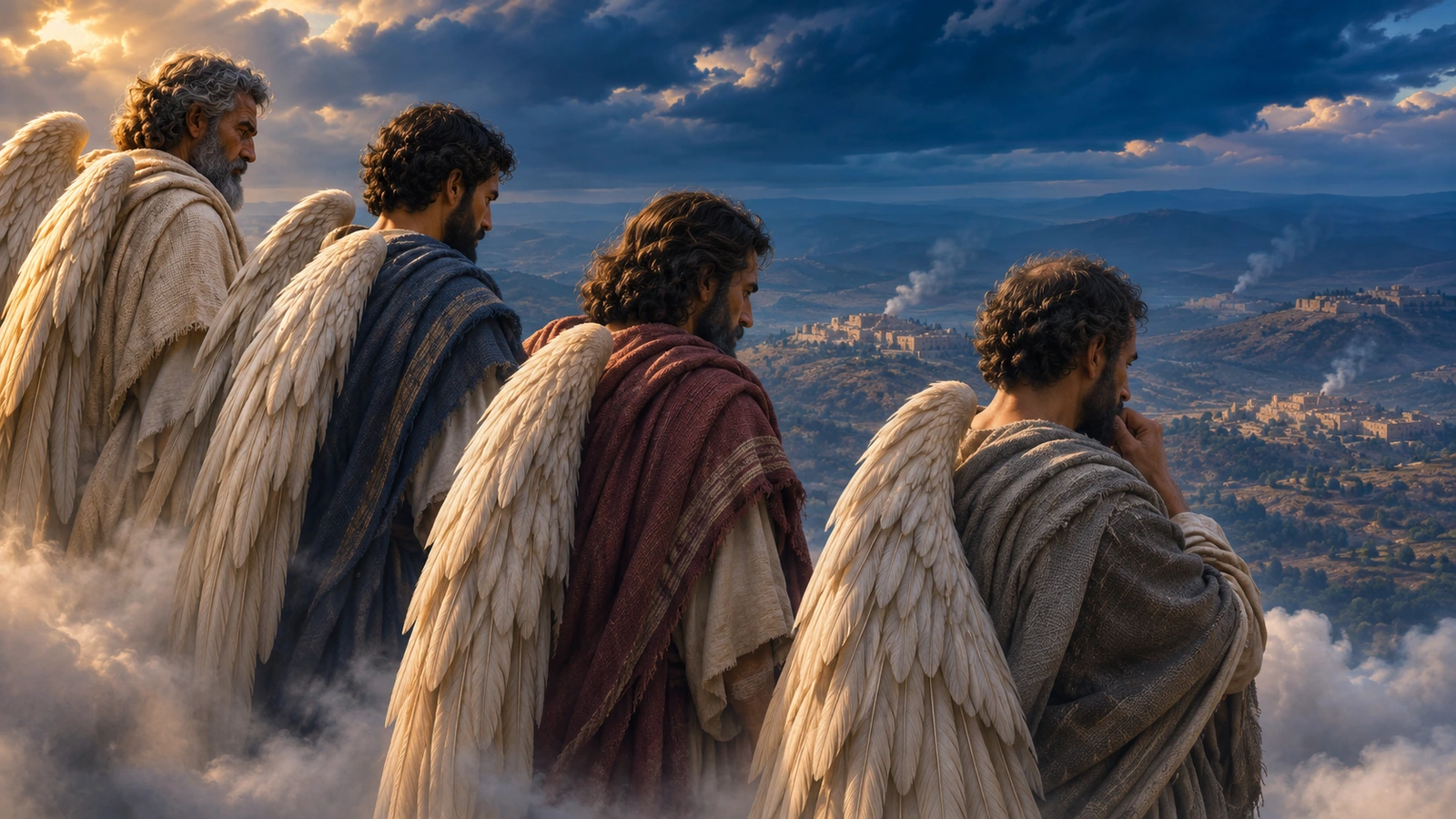
In the Book of the Watchers, Enoch first asks his audience to watch the sky. Before any heavenly being descends in chapter 6, Enoch asks his hearers to notice what keeps its appointment: lights rise and set, rain comes, trees lose and renew their leaves, and summer heat sends people into the shade. In 5:4 the reason for the exercise becomes unmistakable. Human beings have heard a command and turned aside from it. Creation’s fidelity supplies the comparison by which their conduct can be judged. Chapter 1 already mentions the Watchers (1:2, 5). What follows the accusation is the account of their rebellion in chapter 6.
In The Manuscripts of 1 Enoch: Aramaic Fragments from Qumran, Greek Witnesses, and the Ethiopic Text, we followed the physical evidence for the collection. Here one fragment will help answer a literary question. Can we see the turn from observation to accusation in an early witness, and what difference does it make to the way we read the descent? References below follow George W. E. Nickelsburg and James C. VanderKam’s Hermeneia translation of 1 Enoch. The opening chapters are short enough to read alongside the discussion.
The weather comes after a vision of judgment
Begin a chapter earlier than the trees. In the first chapter the prospect of God’s coming unsettles things that look permanent. Mountains and hills give way in the vision; judgment reaches those who have spoken against God. Chapter 2 then asks its audience to look at the dependable behavior of the heavens. These scenes make rather different demands on the imagination. In one a mountain cannot hold its ground. In the next an observer can count on a light appearing in its appointed course. Both scenes belong to the introduction.
Why put them together? If the presentation began with a placid landscape, the instruction to observe might sound like an invitation to find relief outside human affairs. But an audience coming directly from 1:9 has just heard about wicked deeds and proud speech. Those charges return in 5:4. The landscape lies between the announcement of judgment and a sharper identification of its human targets. The reader already knows the kind of question to bring into the field: what does the way a creature acts disclose about its relation to its maker?
The contrast also prevents a mistaken conclusion about regularity. Enoch can present the seasons as dependable and envisage divine judgment disturbing the landscape without treating one statement as an embarrassment to the other. In this literary setting, both convictions depend on the authority of the one who made the world. The text does not propose a mechanism for the movement of the lights or for the collapse of a hill. It asks what the audience can recognize from an ordinary year before it hears an extraordinary account of rebellion.
An appointment in the sky
The first instruction in 2:1 directs the eye upward. Rising and setting are observable changes, so from the first example it is clear that constancy cannot mean remaining in the same spot. A heavenly light keeps its course by moving. Its appearance has a time. The next instruction turns downward toward the earth and makes a remarkably sweeping claim about the continuity of God’s works. Read in isolation that claim might imply a world in which nothing ever looks different. Read beside the account of a rising light it means something considerably more interesting.
The passage teaches its readers how to compare appearances across an interval. Look just once and the sun may be high or low; come back at the appropriate time and a relation between appearances emerges. A bare branch in one season and foliage in another will make the same point on a longer scale. The recurring imperatives ask for a kind of sustained attention. The desired conclusion requires more than a striking view of the heavens on a single evening.
There is a small editorial difficulty in 2:3. Nickelsburg and VanderKam print part of the transition to the signs of summer and winter in angle brackets and identify the wording as uncertain. A study Bible reader may be accustomed to assuming every smoothly printed sentence has the same degree of manuscript support. Here the edition signals a proposed repair. Fortunately the larger argument is not riding on the precise order of two reconstructed phrases. Water, clouds, dew, and rain belong to the winter description in the printed text, and the sun’s heat receives its own sustained treatment in chapter 4. Those examples establish the seasonal comparison without making an uncertain clause bear more weight than it can carry.
Why count the trees that keep their leaves?
Chapter 3 begins with the appearance of withered trees stripped of their leaves. Then comes a detail that could easily have been omitted from a general exhortation: fourteen trees retain their old leaves until replacements come after a longer interval. The list of their names never follows. Neither the number nor the delay should be converted into a chart of modern species. The text supplies a distinction in visible behavior; it gives no botanical key with which to identify every member of the group.
The exception matters because it makes a poor fit with a shallow version of the argument. If Enoch wanted to demonstrate that all trees look alike at the same time, leaf retention would be an inconvenient counterexample. He takes the time to mention it. An observer who has actually walked among trees in winter would know why the qualification is necessary. One bare hillside does not exhaust what there is to see. Different patterns of renewal belong within the order the writer attributes to the Creator.
Notice also the gap between appearance and outcome. A tree in chapter 3 can look withered. In 5:1 trees carry fresh green leaves and fruit. The earlier impression would make a bad final judgment about the life of the tree. One does not have to assign a secret meaning to each leaf to see what the sequence requires of a reader. Wait long enough to see what happens. The illustrator has chosen a fig branch to make leaf renewal visible. Enoch supplies the observation about trees; the choice of a particular species belongs to the illustration.
The hearer steps into the shade
Chapter 4 contains the most bodily example in the passage. The heat makes the earth difficult to tread, and the people addressed look for shelter. The observer of the stars could seem to stand outside the order being observed. Someone looking for shade plainly does not. The changing relationship between sun and ground determines where the hearer can comfortably put a foot. Read that little scene before taking the description of order to mean that the natural world is uniformly gentle.
Summer supplies the uncomfortable half of the comparison. The reader accepts the evidence for the sun’s activity by responding to it. A person may say nothing at all about the order of creation and still seek shade. The speaker is therefore not trying to persuade an audience that has never recognized a pattern in the world. He addresses people whose everyday conduct already shows that they can recognize one. The harder question is why they fail to respond to divine instruction with comparable attention.
That inference has limits. The passage does not say that suffering in the heat is a punishment for particular sins. Everyone who tries to walk on hot ground has reason to move. Nor does the move into shade itself constitute disobedience. The action gives the speaker and his audience common ground in lived experience before the accusations of chapter 5 divide the audience according to conduct. Turning the heat into a punishment too early would spoil that carefully timed change of address.
Another seasonal passage gives a different answer
The pairing of seasons also occurs at the end of the flood narrative. In Genesis 8:20–22, Noah offers sacrifice, and the Lord resolves that the recurring rhythms of life on earth will continue. The human heart still poses a problem in verse 21. A reader coming to Enoch from Genesis might consequently expect the succession of heat and cold to serve chiefly as assurance that the world will endure. Enoch takes an observation familiar from that promise and puts the hearer in a different position.
In Genesis the speech reports a divine resolve after devastation. Noah has survived the waters. In the opening of 1 Enoch a seer addressing the audience urges them to use their senses, and the account of the Watchers and the damage they cause still lies ahead. The difference in speakers alone should caution against reading the two passages as interchangeable statements about providence. One explains why a devastated earth can once again sustain a harvest. The other asks what people who regularly reap the benefits of ordered seasons have done with the instructions given to them.
The comparison gives a useful check on any proposal that Enoch treats seasonal regularity as sufficient evidence of human guilt. The continuing harvest in Genesis coexists with a diagnosis of the human heart, yet the force of the scene is a promise. The leaves and rivers in Enoch acquire their accusatory force from the words placed around them, particularly the direct address in 5:4. The recurrence of the same natural phenomena across two works can illuminate a difference in their arguments. It does not, by itself, establish which text an ancient author had open while writing.
The sentence that changes the subject
In 5:1–3 the survey reaches leaves and fruit, then sea and rivers. These last examples are particularly well chosen. Moving water is hardly an emblem of immobility. Its activity can nevertheless be described as carrying out the Creator’s word. The speaker now names the maker whose authority makes the preceding examples comparable. Trees, lights, and water do very different things. Their relation to a command allows the writer to bring them into a single argument.
Then comes the small phrase “But you” (5:4). There were people in the summer scene already, and the speaker has addressed an audience throughout. What changes here is their role. They cease to be witnesses called to inspect evidence and become the people whose actions are inspected. Proud speech gives the charge a concrete object. The charge in 5:4 recalls the proud words for which sinners face judgment in 1:9.
The verdict that follows uses time quite differently from the lessons about a tree. Those accused must reckon with the days and years of their own lives and with what their names will mean to others. Those identified as chosen are associated with mercy, wisdom, and peace (5:5–9). A season returns as a matter of course. The pronouncement over a person is morally differentiated. The text draws an analogy from nature and then stops short of suggesting that righteousness returns automatically with the next rains.
This is important for identifying the accused. The blessing of the chosen and the denunciation of sinners already distinguish hearers before chapter 6 shifts into narration. Nothing in 5:4 identifies its addressees as the group on Hermon. The gathering on the mountain belongs to the next episode (6:4–6). Conversely, making the opening a generalized condemnation of all humans without distinction would leave the promises at the end of chapter 5 unexplained. The address asks readers to locate their conduct within a moral division, not simply to identify the species to which they belong.
Reading the accusation on a Qumran fragment
For a check on the wording at this turning point, look at J. C. Greenfield’s exhibition translation of 4Q201. Choose column ii, lines 12–14, rather than the adjoining selection about the Watchers’ wives. In line 12 the translated wording accuses the hearers of changing their deeds. In line 13 some wording concerning a command is supplied in brackets. In line 14 the warning that they will have no peace stands outside the brackets. The marks matter as much as the chapter number when deciding what evidence to cite.
Here is a comparison a reader can carry out without knowing Aramaic. Set Greenfield’s line 12 alongside the beginning of 5:4 in the Hermeneia edition. In the former, the charge is expressed in terms of the hearers changing what they do. In the latter, the hearers are accused of failing to stand firm. The English formulations converge on inconstancy but give the ear a different cue. Greenfield’s formulation makes the contrast with the works that keep their course especially audible. The Hermeneia rendering connects readily with the charge of turning aside later in the verse. Either way, the accused have become the grammatical subject.
How much has the comparison established? The published fragment supports an early Aramaic form of the direct accusation and its warning. It does not establish that every word of the continuous English version can still be read on the surviving surface. Neither does a difference between two English translations by itself demonstrate a disagreement between two ancient languages. To make that stronger claim one would have to examine the underlying readings and each translator’s decisions. For interpreting the opening, the more modest result is enough: the pivot toward the hearers belongs to early manuscript evidence and does real work in the passage.
The Deeper Discovery
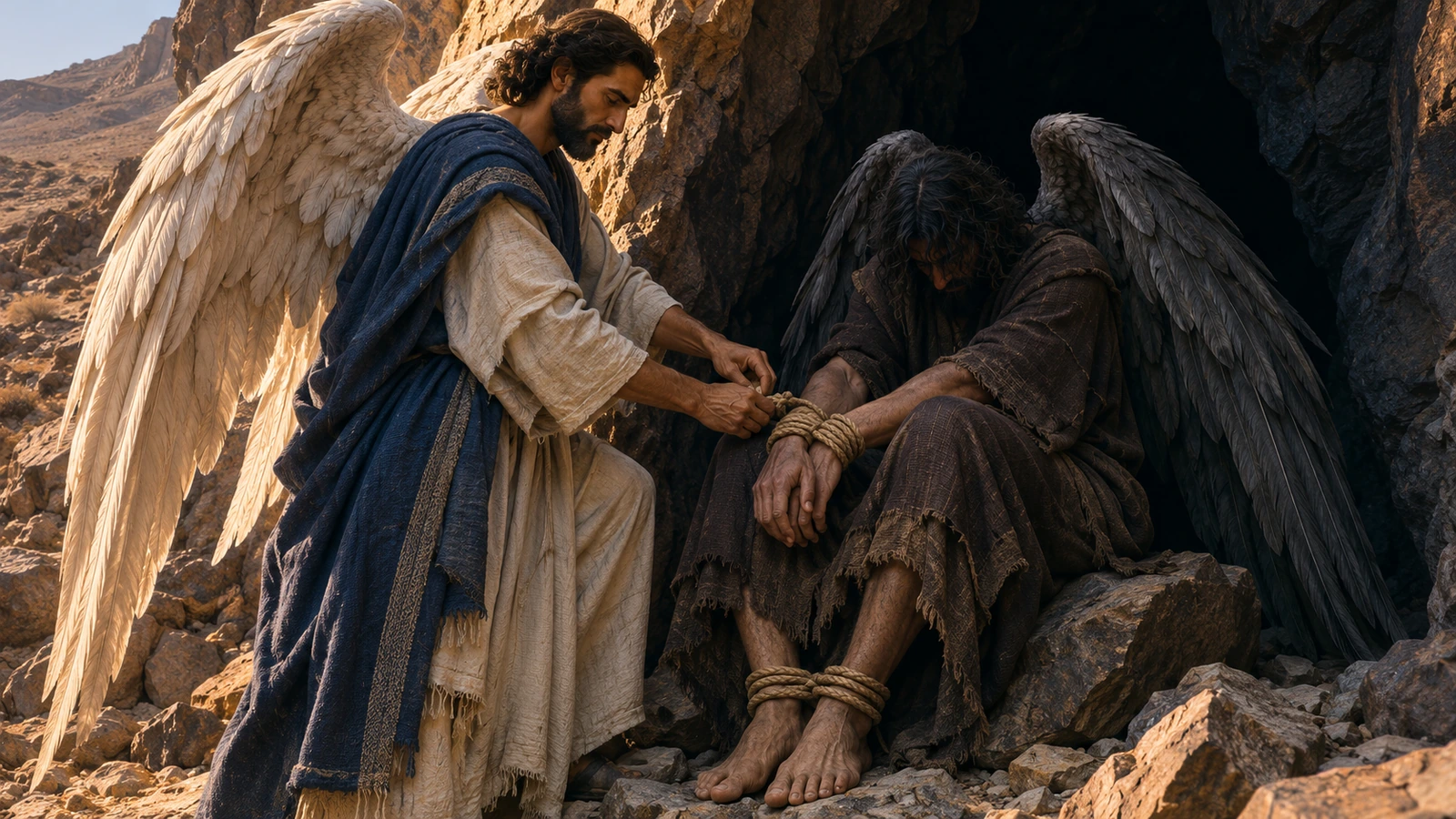
In chapter 6 the Watchers will agree among themselves and bind one another by an oath. That scene is easily remembered as the collapse of order into chaos. Yet the first thing these rebels do together is impose a kind of order on their own undertaking. Their leader raises the danger of being left to bear the consequences alone. The group’s agreement addresses his concern, and the descent proceeds. Loyalty to an agreement can serve a wrongful purpose.
The seasons give the reader a standard by which to notice the difference. The luminaries follow times allotted to them. The Watchers undertake an obligation of their own devising that carries them across a boundary. Both exhibit coordinated action; only the former illustrate fidelity to the maker’s word. Reading chapter 6 on its own, one might take the oath primarily as an explanation of solidarity among the rebels. Coming from chapters 2–5, one can also recognize how severely that solidarity falls short of the faithfulness the passage has taught the audience to look for.
The order of presentation has a final consequence for responsibility. Before the audience can use the story of rebellious heavenly beings to account for evil on earth, it has already heard questions about human deeds and human speech. The Book of the Watchers can give its heavenly actors a consequential role without granting human hearers an alibi. The green branch at the beginning belongs to that demanding argument. Someone able to recognize its appointed renewal is being asked what can be recognized in the use of their own voice.
FAQ
Is this passage part of the Astronomical Book?
It belongs to the opening of the Book of the Watchers. Its observations supply evidence for an accusation and a verdict. It offers no calculations for constructing a calendar.
Does chapter 3 give the names of the fourteen trees?
No names are supplied in the passage. Its point depends on a visible difference in the retention of leaves, and the illustration’s fig tree is an editorial choice.
Why do editions mark part of 2:3 with brackets?
In the Hermeneia edition the translators mark a proposed emendation in a difficult transition. In the exhibition translation of 4Q201, square brackets identify restorations in a damaged fragment. Consult the conventions of the edition being read.
Where can I check the shift from the landscape to the accusation?
Read 5:1–4 in sequence, then compare the last verse with Greenfield’s translation of 4Q201, column ii, lines 12–14. The examples named just before the accusation are the sea and rivers.
What Comes Next?
The account now turns to the mountain and a decision made collectively. Why does the leader raise the prospect of bearing the penalty alone, and how does the oath answer him? Explore the Ancient Texts collection. Next study: Why Do the Watchers Swear an Oath on Mount Hermon in 1 Enoch 6?
Selected Sources
George W. E. Nickelsburg and James C. VanderKam, 1 Enoch: The Hermeneia Translation, especially 1:2–6:6, pp. 19–24. Primary reading text and translation notes on the uncertain transition at 2:3.
J. C. Greenfield, English translation of 4Q201 in the Dead Sea Scrolls exhibition, based on J. T. Milik’s transcription as amended by Greenfield. Column ii, lines 12–14, supplies the documentary comparison for 5:4.
Genesis 8:20–22, New American Bible, Revised Edition. Biblical comparison for seasonality in a divine promise after the flood.