Why Does the Earth Bring an Accusation in 1 Enoch 7?
Before the earth speaks, the people who work it lose both their harvest and their lives.
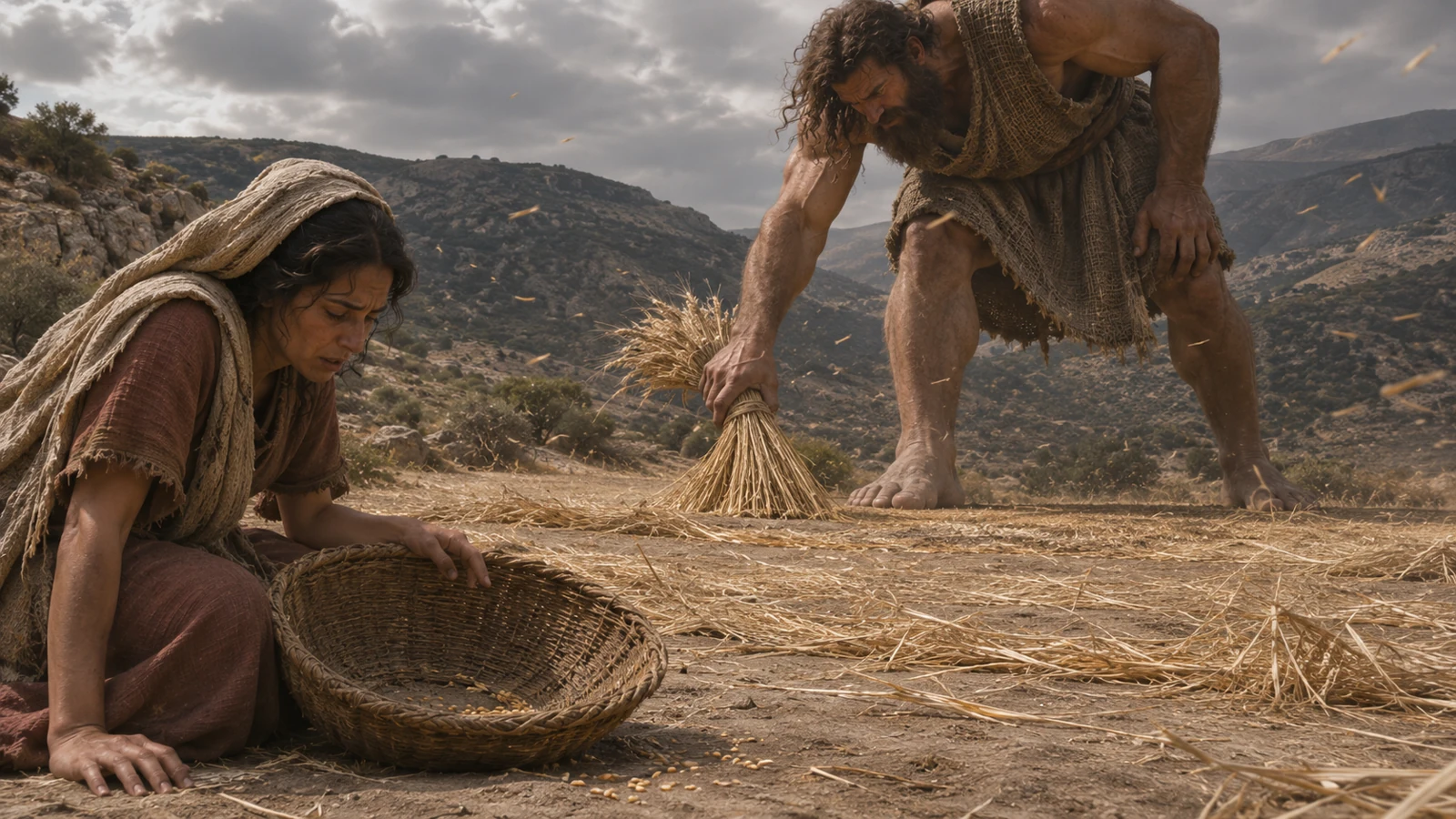
Source: AI-generated editorial illustration for Beyond The Known.
The earth brings an accusation in 1 Enoch 7 because the giants have made ordinary life on it impossible. They consume what people produce, turn upon the people who can no longer feed them, and extend the violence to other living creatures. Blood is drunk. At the close of the chapter the earth speaks as an accuser. The story has moved from a question of how anyone can supply these children to a question of who can speak for those they are destroying. An accusation opens the case. Judgment and the orders that carry it out still lie ahead.
The question left by Why Do the Watchers Swear an Oath on Mount Hermon in 1 Enoch 6? concerns the people who had no voice in that agreement. The Watchers could promise one another that they would go through with their plan. They could make no such undertaking on behalf of the women they chose or the people whose work their children would consume. Follow the verbs through chapter 7 and the consequences acquire subjects of their own. At first the Watchers act. Then their offspring act. By the last line the earth itself has something to do.
Who enters the human world, and who is born into it?
This reading follows George W. E. Nickelsburg and James C. VanderKam’s 1 Enoch: The Hermeneia Translation, especially pages 24–26. Its opening pronoun in 7:1 reaches back across the chapter boundary. The chiefs just listed and the others with them take wives from among the women they choose. The actors are the heavenly Watchers who descended in chapter 6. The children born in 7:2 belong to the next generation. Thus the giant in the illustration represents an offspring living off human labor. A picture of a fallen angel taking the grain would give the deed of the sons to the fathers.
The distinction continues to matter after the births. Verse 1 assigns the initial teaching of charms and the cutting of roots to the visitors. The offspring enter the account through their growth and their feeding. Collapsing the two groups into a single race of monsters makes the list of teachers in chapter 8 almost unintelligible. Why single out a chief to name what he disclosed if his most memorable deed has been eating the people he taught? The narrative can hold the parents responsible for initiating the disaster while giving the children responsibility for particular acts of their own.
The human women occupy another position again. The verbs of choice belong to the heavenly visitors. The wives become pregnant and give birth. Their reported actions include no speech about the marriages and no decision about how to feed the children. An illustrator must give a particular human figure a posture and a face. Nothing identifies the woman in the accompanying scene as the mother of the giant beside her. She stands for people whose efforts no longer suffice. Keeping that distinction allows the passage to say something about the social reach of the damage without assigning a motive to a woman whose thoughts the narrator never records.
A damaged line and an extraordinarily precise height
How large are these children? Readers comparing editions often arrive with a precise measurement in mind. In R. H. Charles’s English chapter VII, the reader meets giants measuring three thousand ells. In the main text printed by Nickelsburg and VanderKam, verse 2 moves through a succession of offspring. Giants beget Nephilim, and another generation follows. The final name, Elioud, carries critical marks in the printed translation. Someone who puts the number from Charles and the succession from Hermeneia into a single quotation has constructed a verse that neither of those English pages prints.
There is a way to investigate the difference without pretending to settle the entire history of the passage. Consult the exhibition transcription and translation of 4Q201, the Aramaic Enoch manuscript from Qumran. The entry dates the copy to about 200–150 BCE. J. C. Greenfield translated the excerpt from J. T. Milik’s transcription with amendments. In the second extract, column iii, line 16, first locate the break inside the word for giving birth in the English presentation. The words identifying the children and giving a numerical height appear on the restored side of that break. The surviving portion already attests pregnancy and the beginning of the next expression. The printed number does not have the same documentary standing as those preceding words.
Compare the line immediately above it. In line 15 a word about sorcery is outside the opening bracket, while further details about spells, roots and herbs are supplied within it. The bracket does a job that quotation marks alone cannot do. It lets an editor present a plausible sequence for readers while showing where the fragment ceases to supply continuous evidence. Reading past both brackets as though the parchment were intact would make this early copy sound far more decisive about the giants’ measurements than the exhibition permits. Ignoring everything restored would create the opposite impression that the fragment tells us nothing about what is happening here. The words about teaching and pregnancy give the passage a definite setting.
The two modern readings invite different questions. A reader of Charles may try to picture a body of such dimensions. A reader of Hermeneia may wonder how the three groups of descendants relate. Both questions arise from real editions. Neither is necessary to understand what the next verse demonstrates. The narrative measures the offspring against the capacity of the community to sustain them. It supplies a threshold one can recognize even without agreeing on an ancient unit of length. Eventually all the work people can do is insufficient. That threshold, rather than an artist’s scale drawing, marks the turn toward killing.
What runs out before the killing begins?
A small choice of English words affects the scene one imagines. In 7:3 Charles speaks of human acquisitions. Nickelsburg and VanderKam bring the labor of human beings into view. Acquisitions suggest things accumulated and now available to be taken. Labor draws the reader’s attention to the continuing activity behind those things. In either case the next clause describes the inability of people to keep their dependents supplied. The difficulty could persist after every existing store had been emptied. There is no indication that the giants contribute labor in return or ever reach a size at which the people can meet the demand.
Picture the difference between missing a meal and losing the means of preparing the next one. A family can share the contents of a basket and return to the field for more. If everything it can reap is taken, it loses the benefit of the very work that would replenish the basket. The threshing floor in the illustration gives that distinction a visible setting. The passage specifies neither grain nor a particular technology for processing it. Its broader expression includes what a household can produce, and would lose, across many kinds of work. No harvest failure or divine withholding of rain is needed to explain the shortage in this account.
Verse 4 then changes the object of consumption. The people who supplied food now become victims themselves. This is one reason to read verses 3 and 4 as a sequence. Starting with a portrait of creatures already given to killing obscures the earlier dependence. Starting with an explanation that blames humans for withholding supplies misstates what the text says about their capacity. They cannot keep up. The giants’ next act reveals what the earlier arrangement was worth to those who benefited from it. Once the providers can no longer provide, their own lives are taken as another resource.
The narrator gives the reader no access to the private thoughts of a single giant at that moment. Hunger may be part of the scene, but attributing calculated economic policy or individual remorse would take us past the evidence. What the account does give is an order of actions and a change in their consequences. The same generation that depended on the work of human beings destroys the people who did the work. The earth’s eventual complaint can therefore embrace both what has happened to the victims and what has happened to the conditions on which future life depends.
Why count birds, beasts, crawling creatures and fish?
The next verse could have continued by counting the human dead. Instead, it changes the reader’s field of vision. Its list reaches into the air, across the land and into the water. Including fish is especially telling. They played no part in the oath on the mountain, in the choice of wives or in the failure to keep the giants supplied. A story interested only in revenge against human providers would have little reason to include them. Once the catalogue is heard, an injured household or an aggrieved village can no longer stand for everyone who has suffered.
It is worth observing what the verb actually licenses a reader to say. The translation describes sin against these creatures. It goes on to speak of eating flesh and drinking blood. A modern retelling might devise a separate episode for each kind of creature, complete with a spectacular act of cruelty for each one. The source has compressed the damage into a list. Its compression works because the reader can recognize entire kinds of life in the space of a sentence. The phrase about devouring one another also introduces a problem of reference. A claim that every named species carried out a particular act against every other would require far more precision than that pronoun provides.
Blood at the end of the sequence prepares for what the heavenly observers will see in 9:1. From their vantage point, the visible condition of the earth is evidence of what has happened below. Put the two perspectives together. In 7:5 the narrator describes the drinking of blood at close range. Chapter 9 steps back far enough to see the land marked by bloodshed. The story does not require a survivor to have stood in every damaged place and counted every injury before the case can be brought. Its widening scale helps explain why so unusual a complainant is appropriate.
Who speaks, and to whom?
The final verse of chapter 7 is remarkably economical. It names an accuser and identifies the accused by their lawlessness. It gives no transcript of an indictment, no spoken answer from a judge and no account of a sentence being imposed on the spot. Charles describes the earth laying its accusation against the lawless. Hermeneia likewise presents the earth as the acting subject. The effect turns on grammar as much as imagery. For five verses, the earth could be imagined as the setting in which someone else does something. At the end it acts in its own right.
A close biblical comparison is illuminating precisely where it differs. In Genesis 4:8–12, God confronts Cain after Abel has been killed. What cries from the ground is Abel’s blood. The ground has received it and will henceforth withhold its produce from Cain. Enoch’s scene has many victims and explicitly assigns the accusation to the earth. The two passages share a striking refusal to let a killing disappear when the victim can no longer give testimony. The grammatical speaker and the sequence of the divine response remain distinct. Quoting the words about Abel as if they were the earth’s speech in 1 Enoch would miss both.
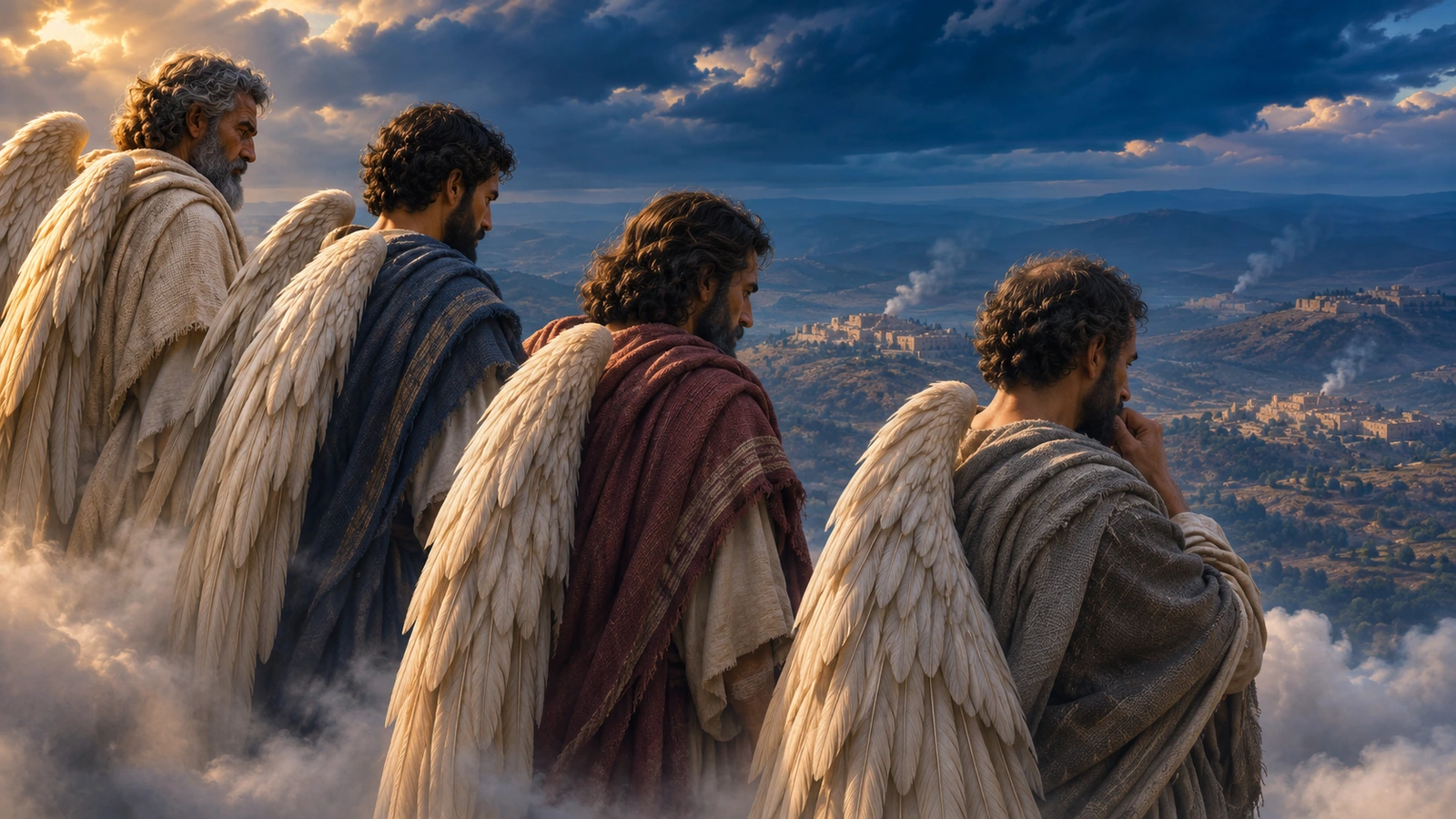
Chapter 9 helps identify the direction of the complaint but should not be used to supply a missing speech in chapter 7. Four holy angels look down on the damage. The souls of human beings appeal to them, and the angels address the Lord. The earth carries the cries toward heaven in 9:2. This sequence gives the dead a voice alongside the earth that has suffered with them. The holy angels serve as intercessors. They are a different group from the rebellious Watchers whose actions initiated the crisis. The Lord to whom they speak holds the authority for judgment. The earth can present a case even though the power to decide it belongs elsewhere.
The Deeper Discovery
Consider what recovery would look like if the only injury were the extraordinary size of the children. The simplest ending would remove them and close the story. Instead, when chapter 10 describes a future for the earth, it gives a surprising amount of attention to cultivation. Vines produce wine, measures of seed yield abundant grain, and olives produce oil (10:16–20). The numbers belong to a vision of abundance. They make an especially telling answer to an earlier passage in which no amount of human labor could supply the people who consumed its fruits.
Read those two accounts of production side by side. In chapter 7 there is already labor, but people cannot live on what their labor brings in. The devastation begins well before the last living thing has been touched. In chapter 10 people can again plant and expect the result to sustain life. The imaginative reversal concerns who gets to enjoy a harvest as much as how large that harvest is. A field can be cultivated and still belong to a world crying for judgment. Cultivation becomes a sign of restoration when a future once consumed by the giants is again available to those who sow.
That connection also explains something a purely human accusation would leave unresolved. A court could punish an offender and acknowledge a victim while the land remained devastated. The earth that accuses in chapter 7 has a future in the narrative beyond giving evidence against the lawless. It too is to be cleansed and made fruitful. The change gives the reader a way of recognizing how far the answer to its complaint must reach.
FAQ
Does the Aramaic fragment preserve the earth’s accusation?
The excerpt of 4Q201 displayed in the exhibition ends its second selection at column iii, line 16. It illuminates the beginning of chapter 7. The wording of 7:6 in this study comes from the continuous Hermeneia translation.
Does Genesis 6 identify the earth as an accuser?
Genesis 6:11–13 describes corruption and lawlessness in the setting of the flood. The specific act of bringing an accusation in the giants’ story belongs to 1 Enoch 7:6.
Is Enoch the person reporting the crimes to the angels in chapter 9?
The appeal in 9:2–4 comes from the souls of human beings, and the holy angels present the matter to the Lord. Enoch’s later role in carrying a petition for the Watchers is a separate episode.
Does the text identify the first person the giants killed?
The account speaks collectively about the people attacked. It gives no name or individual history for a first victim.
What Comes Next?
The next chapter returns to the teachers. It asks readers to follow particular kinds of knowledge from the angel who disclosed them to the people who put them to use. Explore the Ancient Texts collection. Next study: Why Does 1 Enoch 8 Name the Watchers Who Taught Forbidden Arts?
Selected Sources
George W. E. Nickelsburg and James C. VanderKam, 1 Enoch: The Hermeneia Translation, pp. 24–26, 30. The sequence of violence, the heavenly appeal and the agricultural imagery of restoration.
“Enoch (Hanokh),” Dead Sea Scrolls exhibition, 4Q201. Column iii, lines 15–16, translated by J. C. Greenfield from Milik’s transcription with amendments. The brackets distinguish restored material from surviving wording.
R. H. Charles, The Book of Enoch, chapter VII. Comparison of the height, the description of human possessions and the final accusation.
Genesis 4:8–12, New American Bible, Revised Edition. The voice of Abel’s blood and the ground’s role in the account of Cain.