The Book of Enoch: What It Is, When It Was Written, and Why It Matters
The Book of Enoch—more precisely, 1 Enoch—is an ancient Jewish collection of writings attributed to the biblical patriarch Enoch. It was not written as a single book at one moment, and it does not tell one continuous story. Its major sections were composed by different authors over several centuries, largely during the Second Temple period. The work matters because it preserves an influential Jewish interpretation of Genesis 5–6, gives rare access to ancient debates about evil and judgment, survives in an unusually complex manuscript tradition, and stands behind language used in the New Testament letter of Jude.
Those facts make 1 Enoch historically important. They do not make every modern claim about it true. The book was not a newly discovered “lost chapter” of the Bible, nor can its eintire content be traced directly to the Enoch named in Genesis. To understand it responsibly, we must separate the ancient text from the legends now built around it.
First, Which “Book of Enoch” Do We Mean?
The title can be confusing because several ancient works were associated with Enoch. Scholars normally call the work discussed here 1 Enoch to distinguish it from 2 Enoch, a different apocalypse preserved mainly in Slavonic, and 3 Enoch, a much later Hebrew mystical work. The three books are not volumes of a single ancient series. They arose in different languages, periods, and religious settings.
First Enoch claims the authority of Enoch, the seventh patriarch from Adam, whom Genesis describes in only a few sentences: “Enoch walked with God; then he was no more, because God took him” (Genesis 5:24). That brief and mysterious notice invited later interpreters to imagine what Enoch saw, learned, and wrote. The attribution is therefore pseudepigraphal: the authors speak through a revered figure from the distant past. In the ancient world, this was a recognizable literary practice, especially in apocalyptic works. It is not evidence that the historical Enoch personally composed the surviving text.
1 Enoch Is a Library, Not a Single Composition
The most useful starting point is to think of 1 Enoch as a small library placed under one name. Its five principal divisions differ in subject, style, and date.
The Book of the Watchers (1 Enoch 1–36)
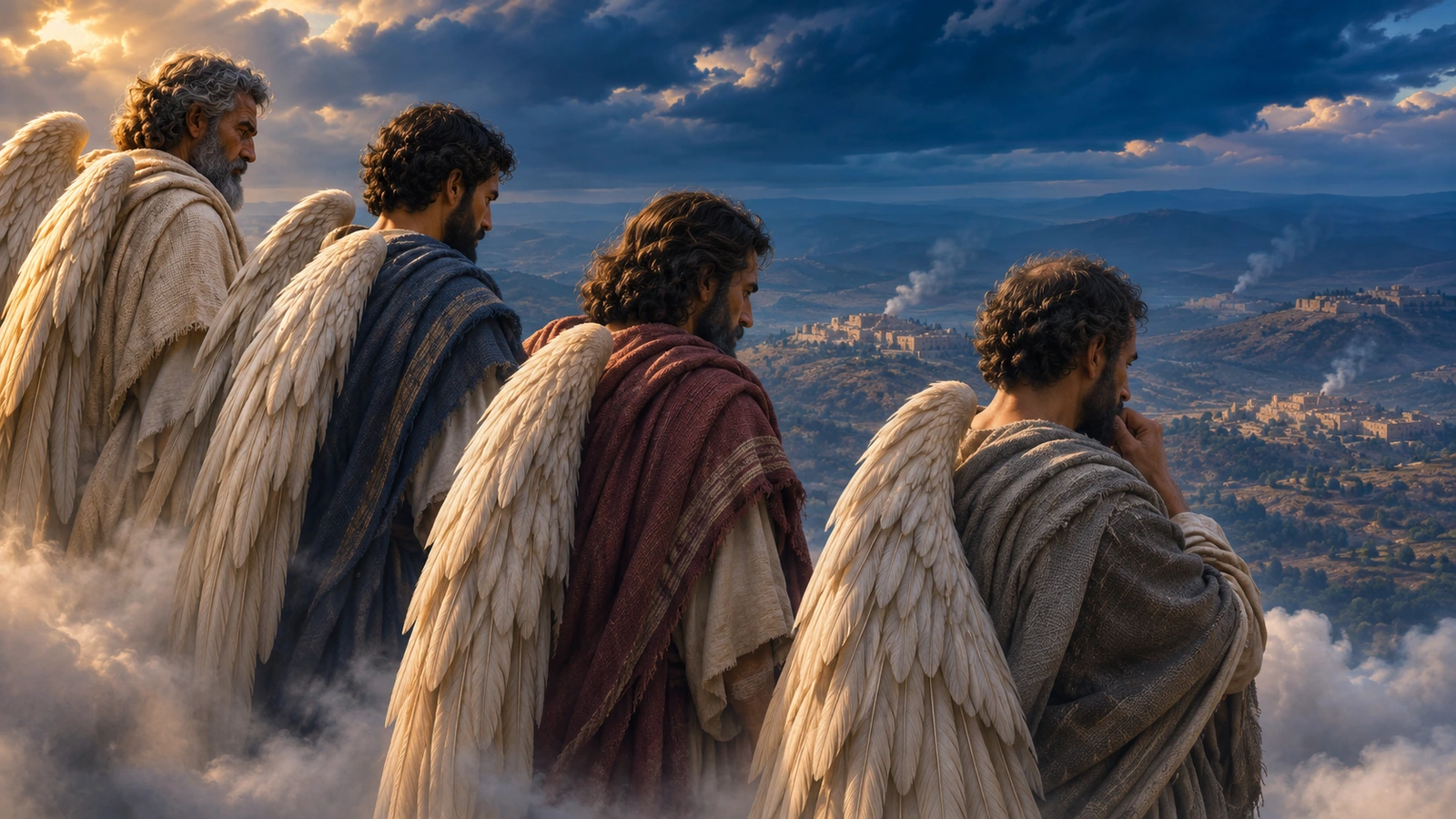
This is the best-known section. It expands the brief account of the “sons of God” and the Nephilim in Genesis 6:1–4. In 1 Enoch, rebellious heavenly beings called Watchers descend, take human wives, transmit forbidden knowledge, and father violent giants. Enoch is commissioned to announce their judgment and is then shown the ordered regions of the cosmos. The section combines biblical interpretation, a diagnosis of evil, and visionary geography.
The Parables or Similitudes (1 Enoch 37–71)
These visions focus on final judgment, the vindication of the righteous, and an exalted figure called the Chosen One, Righteous One, and Son of Man. Because the surviving Qumran fragments do not include this division, its date remains especially debated. Many specialists place it near the turn of the era, but proposals vary. Its language is important for studying Jewish apocalyptic expectations; it should not be treated as a simple prediction chart.
The Astronomical Book (1 Enoch 72–82)
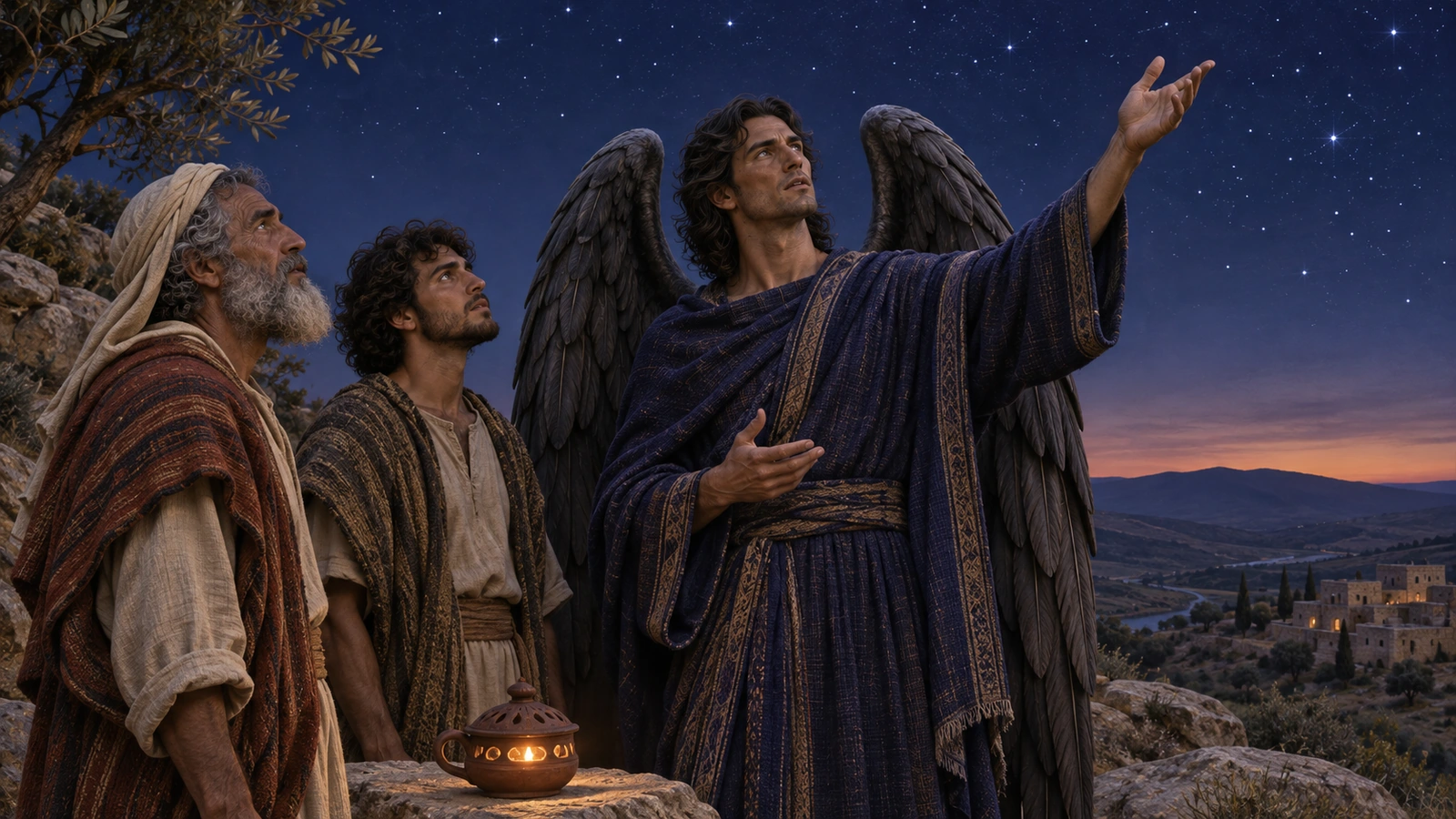
Here the angel Uriel guides Enoch through the courses of the sun, moon, stars, and calendar. To a modern reader, the detailed movements can feel remote. For ancient communities, however, the calendar determined festivals, worship, and communal identity. The section presents the heavens as a realm of stable obedience: celestial order exposes the disorder produced by human and angelic rebellion.
The Dream Visions (1 Enoch 83–90)
Two symbolic dreams retell the flood and the history of Israel. In the longer “Animal Apocalypse,” people and nations appear as animals. The rebellious Watchers appear as stars falling from heaven (1 Enoch 86:1–4). When other angels arrive in the next chapter, Enoch sees them as figures resembling men (87:2). The vision moves from Adam through Israel’s past toward judgment and restoration. Its symbolic survey of history allows scholars to connect its final form with conflicts of the Hellenistic period.
The Epistle of Enoch (1 Enoch 91–108)
The closing collection contains exhortations, woes, revelations, and the Apocalypse of Weeks, which divides history into a patterned sequence. It addresses communities troubled by the apparent success of the wicked. Its central claim is ethical and theological: injustice is not the final structure of reality, even when present experience makes it look that way.
The dates of these units cannot be reduced to one year. The oldest Enochic material is commonly placed in the third or second century BCE, while some sections or editorial layers are later. The collection grew over time. Saying “the Book of Enoch was written in 300 BCE” is therefore too simple; the better question is when each composition and its later arrangement took shape.
How the Manuscripts Survived
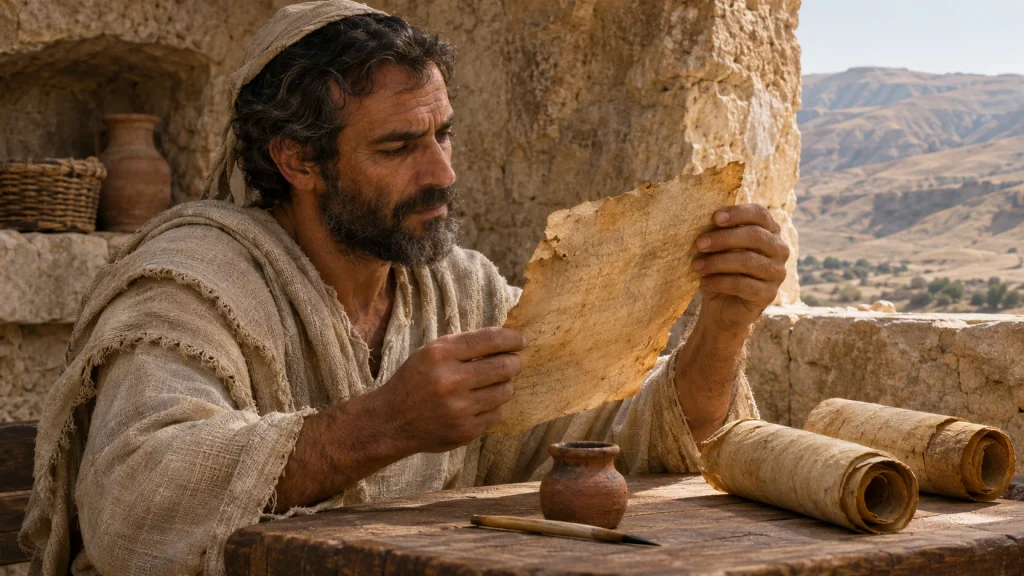
The survival of 1 Enoch is one of the most remarkable parts of its history. The complete work is preserved in Geʿez, the classical language of Ethiopia. Substantial portions also survive in Greek, with smaller evidence in Latin and other languages. For centuries, European scholars knew the complete form chiefly through Ethiopian manuscripts.
The Dead Sea Scrolls transformed the discussion. Aramaic fragments representing most major parts of 1 Enoch were recovered from Cave 4 at Qumran. A copy of the Book of the Watchers known as 4Q201 is generally dated paleographically to around 200–150 BCE. These fragments proved that Enochic writings circulated in Jewish communities well before the rise of Christianity. They also confirmed that much of the work had an Aramaic history behind the later Ethiopic text.
The Qumran evidence does not mean that one pristine “original Book of Enoch” was found intact. The discoveries consist of fragments from several manuscripts, and textual reconstruction requires comparing Aramaic, Greek, and Geʿez witnesses. Nor were the scrolls found in a sealed container labeled “Bible.” The Qumran caves preserved a diverse library: books now in the Hebrew Bible, community rules, commentaries, hymns, legal texts, and works that later traditions classified differently.
Was the Book of Enoch Removed from the Bible?
The short answer is no—not in the simple sense implied by that popular claim. There was no single worldwide Bible from which one authority secretly extracted 1 Enoch. Jewish and Christian canons developed through long, regionally varied processes. Different communities read valued books with different levels of authority, and a text could be respected without becoming part of every community’s scriptural collection.
First Enoch is not part of the Jewish Tanakh, the Roman Catholic canon, or the standard Protestant and Eastern Orthodox biblical collections. It is, however, preserved as scripture in the broader canon of the Ethiopian Orthodox Tewahedo Church and is also received in the Eritrean Orthodox Tewahedo tradition. That history should be described with respect rather than treated as an exotic exception to a supposedly universal Western list.
Early Christian writers knew Enochic traditions, and some cited or defended the book. Other Christians questioned it, and its circulation diminished in many languages while it continued in Ethiopia. “Excluded from most later canons” is historically defensible. “Removed from the Bible because it revealed forbidden truth” turns a complex history into a conspiracy for which the evidence does not support.
Why Jude Quotes 1 Enoch
Jude 14–15 introduces a prophecy attributed to “Enoch, the seventh from Adam” and closely follows 1 Enoch 1:9: the Lord comes with myriads of holy ones to execute judgment. The verbal and thematic relationship is widely recognized. Jude did not merely happen to express a similar idea; he used an Enochic passage in his warning against corrupt teachers.
What does that quotation prove? At minimum, it proves that the author of Jude knew an Enochic tradition and regarded it as authoritative for his argument. It also shows that his audience could understand the reference. It does not, by itself, settle the canonical status of every section of the later Ethiopic collection. Biblical authors can use a source without automatically defining the status of the source’s entire surviving corpus. Paul’s engagement with Greek poets offers a familiar comparison, though Jude’s prophetic introduction gives the Enoch quotation particular weight.
The careful conclusion is stronger than dismissal but narrower than many internet claims: Enochic literature belonged to the intellectual and religious world of at least some early Jews and Christians, and Jude considered its judgment tradition useful and compelling.
Genesis 6, the Watchers, and the Nephilim
The Book of the Watchers offers the earliest extensive interpretation we possess of Genesis 6:1–4. Genesis itself is terse. It mentions the sons of God, daughters of humanity, and Nephilim, then moves rapidly toward the flood narrative. First Enoch fills those silences with names, motives, illicit instruction, giant offspring, and angelic punishment.
This makes 1 Enoch indispensable evidence for the history of interpretation. It shows that some ancient Jewish readers understood the sons of God as heavenly beings whose rebellion damaged creation. That interpretation also helps explain New Testament passages that connect sinful angels with confinement and judgment, especially Jude 6 and 2 Peter 2:4.
But interpretation is not identical to the passage being interpreted. Genesis does not include most of 1 Enoch’s narrative details. A responsible reader should first examine the major interpretations of the sons of God in Genesis 6, then compare the Enochic expansion. The same distinction matters when asking who the Nephilim were or why the flood judgment occurs in Genesis. First Enoch is an ancient witness to how those questions were answered—not a license to insert every later detail into the biblical text.
What Problem Is 1 Enoch Trying to Solve?
Beneath its journeys, angels, and cosmic imagery lies a serious moral question: Why is the world so violent and disordered if God created it well? The Watchers narrative distributes responsibility across rebellious heavenly powers, human participation, and the violence of the giants. Forbidden knowledge becomes dangerous not because learning itself is evil, but because power is detached from its proper limits and used to corrupt creation.
Other sections address the same crisis from different directions. The Astronomical Book contrasts reliable heavenly order with earthly transgression. The Dream Visions place imperial violence inside a history God will judge. The Epistle consoles righteous people who see the wicked prosper. The Parables imagine public reversal: hidden faithfulness is vindicated, rulers are exposed, and judgment restores moral order.
This is why reading 1 Enoch only to identify supernatural beings misses much of the book. Its visions are not a catalog of curiosities. They are arguments about justice, revelation, worship, the abuse of knowledge, and the conviction that visible history does not exhaust reality.
Why 1 Enoch Matters for Biblical Study
First Enoch is valuable because it narrows the distance between the worlds of the Hebrew Bible and the New Testament. Ideas that can seem to appear suddenly in early Christian texts—imprisoned angels, a climactic judgment, heavenly books, cosmic secrets, and the Son of Man as an eschatological figure—were already being explored in Jewish literature. The book does not provide the only background for these themes, but it preserves one of the richest collections of them.
It also corrects an oversimplified picture of ancient Judaism. Second Temple Jewish thought was not one uniform system. Communities interpreted Scripture, calendars, purity, empire, wisdom, angels, resurrection, and the end of history in different ways. Enochic literature is one powerful voice in that larger conversation.
Finally, its manuscript history teaches a methodological lesson. Ancient books do not reach us as abstract ideas. They travel through copies, translations, communities, and editorial decisions. The Aramaic fragments, Greek witnesses, and complete Geʿez tradition are not peripheral details; together they are the evidence from which the text is known.
What the Book of Enoch Cannot Prove
It cannot prove that its visions are eyewitness reports written before the flood. The surviving evidence points to literary production in the Second Temple period, even when the narrative voice is placed in primordial time. It cannot prove that every early Jew or Christian accepted the same angelology. Qumran’s multiple copies demonstrate interest and circulation, not unanimous canonical agreement.
It also cannot serve as a shortcut around the Bible’s own literary contexts. Using 1 Enoch to illuminate Genesis, Daniel, Jude, or Revelation can be historically fruitful. Using it to erase differences between those works is not. Parallel imagery may indicate a shared tradition, direct literary use, or a common scriptural source; each case requires its own argument.
How to Read 1 Enoch Responsibly
Begin with the section, not merely the title of the collection. Ask whether you are reading the Watchers, Parables, Astronomical Book, Dream Visions, or Epistle. Note that their questions and historical settings differ. Use a modern scholarly translation that identifies textual variants and explains where the Geʿez, Greek, and Aramaic witnesses diverge.
Next, read the biblical passage that an Enochic text interprets. Observe what the earlier passage actually says before noticing what the later author adds. Then compare related Second Temple works rather than assuming that 1 Enoch speaks for the entire period. Most importantly, distinguish three levels of confidence: what the manuscripts establish, what scholars reasonably infer, and what remains debated.
That approach does not make the book less fascinating. It makes the fascination durable. The real 1 Enoch—a layered Jewish apocalypse preserved across languages and communities—is more historically significant than the sensational version circulating online.
Frequently Asked Questions
Who wrote the Book of Enoch?
The historical authors are unknown. The collection uses Enoch as its authoritative narrator, but its sections were produced and edited by multiple Jewish writers over time. Attribution to an ancient figure is why the work is called pseudepigraphal.
When was 1 Enoch written?
Its oldest major components are usually dated to the third or second century BCE, while other material is later. The Parables are especially debated and are often placed near the turn of the era. No single date describes the whole collection accurately.
Was the Book of Enoch found among the Dead Sea Scrolls?
Aramaic fragments from multiple manuscripts of Enochic works were found at Qumran, especially in Cave 4. They represent most of the major divisions, though no Aramaic fragments of the Parables have been identified there. The complete collection was not recovered as one intact scroll.
Is the Book of Enoch in the Bible?
It is not part of the Jewish, Protestant, Roman Catholic, or most Eastern Orthodox canons. It is included in the broader canon of the Ethiopian Orthodox Tewahedo Church and received in the Eritrean Orthodox Tewahedo tradition.
Does Jude quote the Book of Enoch?
Yes. Jude 14–15 closely quotes 1 Enoch 1:9 and applies its judgment language to Jude’s opponents. The quotation establishes Jude’s use of Enochic tradition, but interpreters debate what it implies about the status of the entire collection.
The Deeper Discovery
The most important discovery is not a hidden name, a secret calendar, or a forbidden angel. It is that biblical interpretation was already an active, creative, and contested practice before the New Testament was written. First Enoch records ancient readers wrestling with gaps in Genesis, the experience of injustice, the apparent silence of heaven, and the hope that creation’s order will be restored. It lets us hear that conversation in a voice that would otherwise have been nearly lost.
What Comes Next
The next study in this series will move from the collection’s meaning to the physical evidence: The Manuscripts of 1 Enoch: Aramaic Fragments from Qumran, Greek Witnesses, and the Ethiopic Text. It will examine what survives in each language, what the Cave 4 fragments actually contain, and how scholars reconstruct a work transmitted across more than two thousand years.
Selected Sources
- George W. E. Nickelsburg, 1 Enoch 1: A Commentary on the Book of 1 Enoch, Chapters 1–36; 81–108 (Fortress Press, 2001).
- George W. E. Nickelsburg and James C. VanderKam, 1 Enoch 2: A Commentary on the Book of 1 Enoch, Chapters 37–82 (Fortress Press, 2012).
- James C. VanderKam, Enoch: A Man for All Generations (University of South Carolina Press, 1995).
- Michael A. Knibb, The Ethiopic Book of Enoch, 2 vols. (Oxford University Press, 1978).
- Józef T. Milik, The Books of Enoch: Aramaic Fragments of Qumran Cave 4 (Oxford University Press, 1976).
- Annette Yoshiko Reed, Fallen Angels and the History of Judaism and Christianity (Cambridge University Press, 2005).
- Online Critical Pseudepigrapha: 1 Enoch, Society of Biblical Literature.
- “The Qumran Library,” Scrolls from the Dead Sea, Library of Congress.